Amity Behavioral Health Network Locations: How to Compare Care

Amity Behavioral Health Network includes locations with different levels of care in Florida and California. Compare the services actually offered, the daily schedule, travel and support needs, insurance questions, and the next admissions step instead of choosing by destination alone.
- 1Start with the level of care and services being considered, not the state or amenities.
- 2Amity locations do not all provide the same programs, so confirm current services directly.
- 3Travel, family support, work, housing, and the daily schedule can affect practical fit.
- 4Insurance verification can clarify reported benefits but does not determine clinical fit or guarantee payment.
- 5Finish the admissions call with one named contact, one next action, and a follow-up time.
People searching for an “Amity treatment center” or “Amity rehab” may find several locations across Florida and California. The shared name does not mean every location offers the same level of care, schedule, or setting. The most useful first question is not “Which state looks better?” It is “Which location currently provides the kind of support that should be assessed for this situation?”
Amity Behavioral Health Network includes detox, residential, partial hospitalization, intensive outpatient, and outpatient services across different locations. Availability and fit should be confirmed directly because programs, capacity, and admission timing can change.
Start With Level of Care, Not Destination
The National Institute on Drug Abuse explains that no single treatment approach is appropriate for everyone. Services should be matched to the person's needs, and those needs may change during care.
That is why a location comparison should begin with an assessment conversation. Ask which level of care is being considered and what information the team needs before discussing placement. A person who may need withdrawal management or a residential setting is solving a different problem than someone comparing a structured outpatient schedule.
Review Amity's treatment programs before calling, but do not use a website description to diagnose the correct level of care. Ask how substance use, withdrawal concerns, medical history, mental health symptoms, prior treatment, medications, recovery environment, and current safety are reviewed.
Compare What Each Amity Location Actually Offers
The network's locations directory lists distinct program focuses:
- Surf City Detox in Huntington Beach focuses on medical detox and short-term residential treatment.
- Amity San Diego focuses on PHP, IOP, outpatient treatment, family therapy, and relapse-prevention support.
- Amity Palm Beach lists detox, residential, IOP, and continuing-support options.
Use those descriptions as a starting point, then confirm current services and availability during the admissions call. Do not assume that a program offered by one network location is automatically available at another.
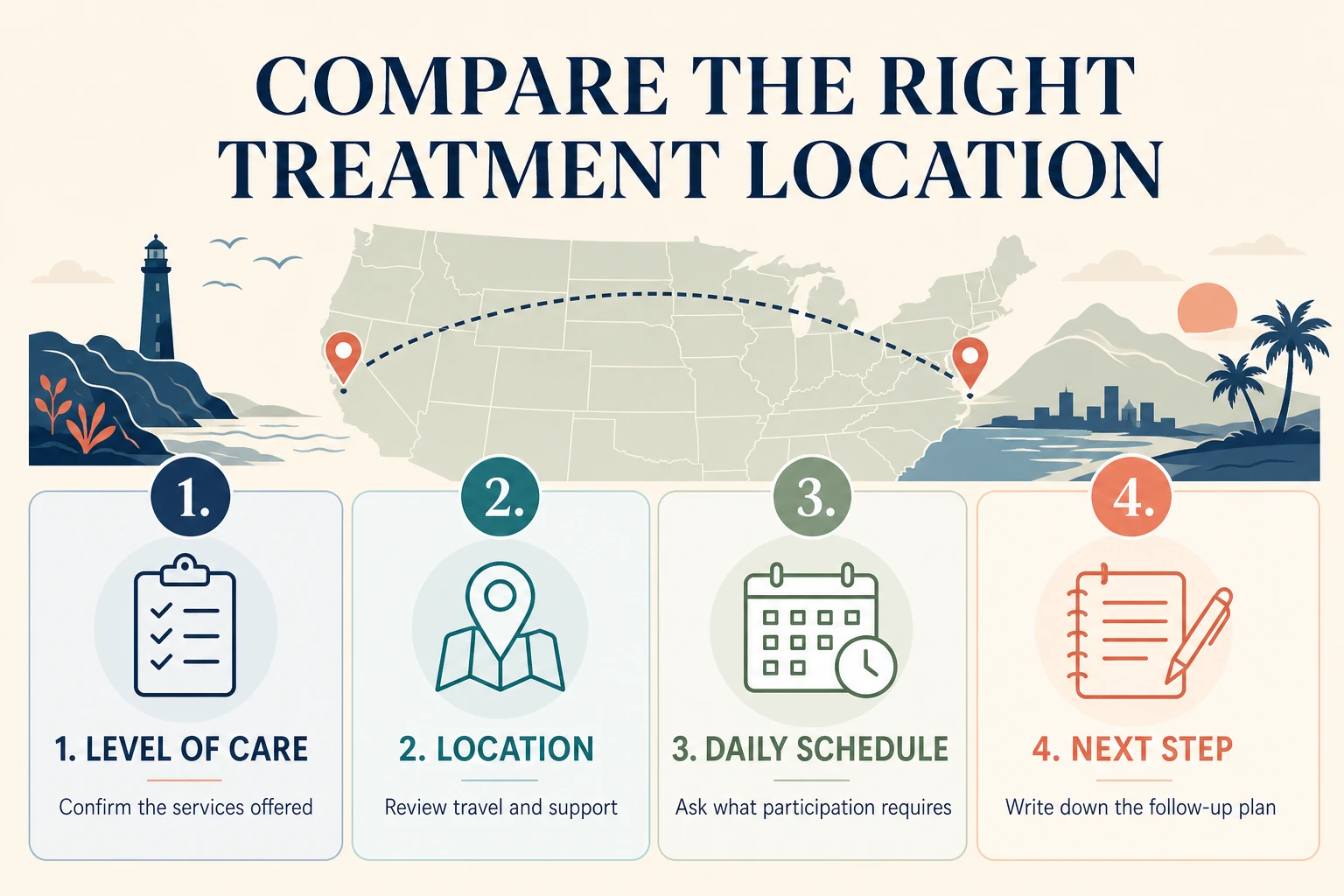
Ask How the Daily Schedule Works
Program names do not tell you everything about the day. Ask how often someone attends, how long a typical day lasts, whether care includes individual and group services, and what participation requires outside scheduled hours.
For outpatient care, bring real work, school, transportation, childcare, and family commitments to the conversation. For residential or detox planning, ask about arrival timing, approved belongings, medications information, family communication, and what happens when a person is ready for a less intensive setting.
A practical schedule should support the recommended care. It should not pressure the care decision into whichever calendar looks easiest.
Consider Travel and the Recovery Environment
Traveling for treatment may create useful distance for one person and unnecessary complications for another. Compare transportation, family involvement, housing, local support, employment responsibilities, and the plan for returning home.
Ask:
- Who can support arrival and discharge planning?
- How will family communication work with consent?
- Will work, school, or caregiving responsibilities interfere with participation?
- What continuing-care support will be needed after the initial program?
- If care starts away from home, how will the transition back be coordinated?
The ASAM Criteria describe treatment planning as considering more than substance use alone, including health, readiness, risk, and the recovery environment. Families do not need to apply clinical criteria themselves. They can provide accurate information and ask how those factors affect the recommendation.
Compare Quality With Direct Questions
SAMHSA recommends looking for licensed or accredited care, qualified staff, evidence-based practices, family involvement when desired, and support for needs beyond substance use.
Turn that guidance into questions for each location:
- What licenses or accreditations apply to this program?
- Which qualified professionals participate in assessment and care?
- How is an individualized plan developed and reviewed?
- How are mental health and medical concerns addressed?
- How does the program plan for the next level of support?
An admissions representative should distinguish general program information from decisions that require assessment by qualified professionals.
Keep Insurance Separate From Clinical Fit
Insurance verification can help identify reported benefits, network status, authorization requirements, and possible cost sharing. It does not decide which location or level of care is clinically appropriate, and it is not a guarantee that an insurer will pay every claim.
Have the insurance card, policyholder information, date of birth, and expected treatment location ready. Ask what has been confirmed, what remains an estimate, and whether the plan requires authorization.
If travel is involved, confirm that the answer applies to the actual facility and service being considered. A general answer about “Amity” may be incomplete when locations, providers, or levels of care differ.
End With a Written Next Step
Before ending the call, write down:
- The location and program being discussed
- Information or documents still needed
- The name and phone number of the contact
- Who is responsible for the next action
- When follow-up should happen
If the first location does not appear to fit, ask what other level of care or network location should be discussed. A clear referral or next question is more useful than forcing a destination-based decision.
Call Amity Behavioral Health Network at (888) 833-3228 to ask about current locations, programs, admissions, and insurance verification. You can also review what to expect during admissions before the call.
This article is for educational purposes only and is not medical, legal, or insurance advice. Program availability and reported insurance benefits can change and should be confirmed directly. If someone may be in immediate danger, call 911 or seek emergency care.
Frequently Asked Questions
Does every Amity Behavioral Health Network location offer the same programs?
No. Amity locations have different program focuses and levels of care. Review the individual location page and confirm current services with admissions before making plans.
How should I choose between a Florida and California treatment location?
Begin with clinical and program fit, then compare travel, support, schedule, insurance, and continuing-care needs. A preferred destination should not replace an appropriate assessment.
Can insurance verification tell me which Amity location to choose?
Insurance verification can clarify reported benefits, network questions, authorization requirements, and possible costs. A clinical and practical fit conversation is still needed, and verification is not a guarantee of payment.
How do I contact Amity Behavioral Health Network?
Call (888) 833-3228 to ask about current locations, programs, admissions, and insurance verification.
Sources & References
Read the sources referenced in this article.
- Quality Treatment for Mental Health, Drugs and Alcohol — Substance Abuse and Mental Health Services Administration (2023)
- Principles of Drug Addiction Treatment: A Research-Based Guide — National Institute on Drug Abuse (2026)
- About the ASAM Criteria — American Society of Addiction Medicine (2024)
Amity BH Clinical Team
Published by Amity Behavioral Health. This article provides general information and is not a substitute for individual professional advice.
Related Programs & Resources
Learn more about our treatment programs and how we can help you recover.
Related Articles
 Admissions
How to Choose Addiction Treatment in West Palm Beach
A practical guide to how to choose rehab West Palm Beach for readers near West Palm Beach, with questions that help match symptoms, timing, support, and an admissions path.
 Treatment Access
Great American Recovery Initiative: Rehab Coverage Guide
A practical West Palm Beach guide to what the Great American Recovery Initiative does, what it does not guarantee, and which rehab insurance questions to verify now.
 Admissions
How Insurance Verification Works for Addiction Treatment
Learn how insurance verification works for addiction treatment, what information you need, and what families in West Palm Beach should expect before admission.
Discuss Your Treatment Options
Contact Amity to ask about assessment, program fit, and services at the location you are considering. Confirm current availability before making plans.
Ask about care options, program fit, and next steps.